Posts

Scrum for Startups - Scaling Scrum? or just a lot of Scrum?

Image
Yesterday I attended Scrum Day Europe , which had the theme 'Scaling Scrum'.  Perhaps predictably, the only one to consider the case: 'natural growth' was Gunther Verheyen .  Everyone who spoke after him was actually talking about how to impose/implement Scrum when you already have lots of people. Startups have the luxury that they can think about scaling before having to do it and can make/choose a framework that they can settle- as opposed to get-crammed-into.

Scrum for Startups - does it work?

Image
I am currently the Agile Coach/Scrum Master/Project Guru (that last, totally unpretentious title was dreamed up by Peter, one of the founders, but it looks cool at the bottom of an email) at a startup, Crunding , which makes mobile apps for end-users.  This is not my first job at a startup, in fact this company is a lot more 'established' than anywhere I have worked in the last few years. Photo: Guian Bolisay When looking at Scrum and Agile, one of the things that strikes me is that the loudest advocates of Agile techniques seem to be working at the least Agile organisations, like banks and in government.  That is of course a good thing: top-down organisations have a lot that they can learn from mindsets that promote innovation. But the startup crowd is very quiet when it comes to getting organised.  If you have a young product, are not stuck in a rut and indeed have no solidified management yet - the eyes are not yet turned inwards and there is perhaps less to ta...

Deep Democracy meets Scrum

Image
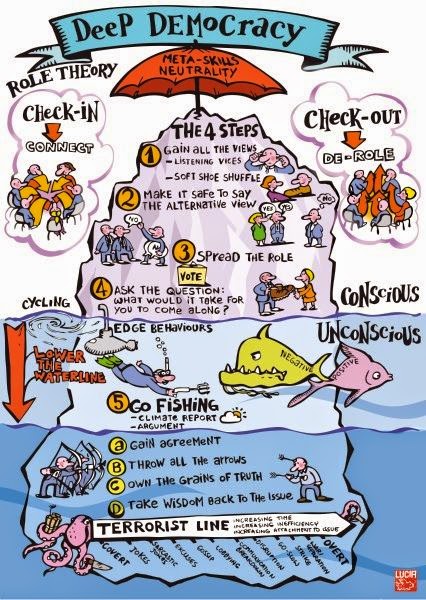
About a year ago, I went to a training given by Sandra Bouckaert and Lydie van de Laar on the basics of Deep Democracy .  My wife was 35 weeks pregnant and I was working on a project with worryingly limited financing so I was not exactly in the perfect 'zen' mindset for a day of mind-battering brainstorming.  I expected to leave the day dazed and confused, yet found myself in the car buoyed up and even excited about what I had just experienced. Deep Democracy is a method developed in South Africa at the end of the apartheid regime and specializes in getting minority views heard.  It is concurrently a team-building tool and an ideation tool. 

Scrum and Yacht Racing - Roles

Image
Watching the development of yacht sailing teams during a campaign, I have always been struck by the similarities between an effective team on a boat and an effective Scrum team. If we take an X-35 team, it has 7 to 9 members.  Each member of the team has a very specific set of skills and a role. A team has a build-up to a race or a series of races in a campaign.  Usually there is a main goal - a certain race that stands out like a world cup - combined with a series of smaller events. Roles To get an idea of a typical modern sailing team, it is handy to understand what everyone does.  Beginning at the back of the boat:

Toute nation a le gouvernement qu'elle mérite

Roughly translated as ‘every country has the government it deserves’ - I am getting used to the idea that this may be truer than even Joseph de Maistre may have meant. I don’t just mean that all our politicians are power-hungry narcissists (something I might not deny), but I mean that humans have, throughout the ages, had leaders that have been created by their followers.  The leaders that floated up, simply had properties that made them buoyant in the social climate that they were in. Usually this quote is used to complain about the corrupt nature of democracy, but that is actually not what I mean.  I mean it more as an emergent property of the masses, that leaders emerge simply because of certain properties (or perhaps lack thereof like ‘ Captain Me ’). Perhaps this clip by ‘CrazyRussianHacker’ can explain what I mean.

Paradigm Shift

Image
On the 15th of October 2011 the Occupy 'movement' set up camp on the Beursplein in Amsterdam. As in most places, the protest got a bit of publicity and then became a small local row, largely ignored by all but the most refined truth seekers on the one hand and the absolute gutter-press on the other. For those closely following the movement, it did give an interesting insight into deft political manoeuvring but for the rest, it was back to business as usual. That is not a pity, it's actually missing the point. The world has changed, almost everyone now knows that the 'system' * we have, will (and probably should) fail at some point. So, what to expect?

How to help Wikileaks

Whatever your opinion may be on the recent 'cablegate' releases from wikileaks, blocking openness with hacking, ddos attacks and bullying is not the democratic way of doing things. What can you do about it?