Posts

A commons approach to LLMs

Image
Yesterday, two of my favourite bloggers go into a spat on Mastodon:  @tante accused Cory Doctrow of 'straw-manning' the anti-slop/Luddite movement in a blog .  Later that day, after a 'that escalated quickly' argument that is usually reserved for x.com, tante published another blog to address the reactions to the original piece.   At first glance, this looks like a ' straw-motte ' discussion - a bait-and-switch tactic that content creators use to capture attention: accusing an offside remark of being a straw man, then building an stone-clad counter argument (a motte), which is then accused by the original party of being a straw man, countered with a motte, which is a straw man, etc. ad-infinitum.  But on closer inspection, it turned out that there was quite a nuanced discussion going on - that is, beside the usual flame war.   The discussion went as follows: Doctrow mentioned in a blog that he uses an LLM to clean up his content.  In the blog...

New Year's Resolutions 2026 - Transformation Chooser

Image
 As 2025 draws to a close, I'm having quite a few conversations about what people want their organisation to look like in 2026. Normally I would of course make a hefty consulting engagement of this, but as this is a time of giving and good cheer - here is a do-it-yourself guide to choosing a transformation:  

Agile is dead - Zombies vs Robots

Image
 Agile (a.k.a. the agile industrial complex) is dead (or dying, or undead... read on). Of course Agile has been declared dead many times, but now we can see that there are fewer visitors to Agile conferences, fewer people looking to get certified as something Agile, fewer people are calling themselves Agile Coach. Dying The Agile conferences have talks about how very large companies do Agile, which tools they use to collaborate or how non-IT departments do Agile, topics that were also there ten years ago. Agile conferences have yet to adapt to topics like decentralized enterprises, fluid teams, remote-only organizations, AI helpers and commons governance. The certification crisis seems to follow a similar pattern: was this ever a good measure? Those courses were meant for setting off down a path that makes you better at discovering and uncovering effective ways of working - perhaps we're running out of people who have yet to start, whilst not offering enough to th...

Drie Agile-transformatielessen van een Agile Coach

Image
  This was a blog post on one of the sites of Highberg , in Dutch.  The blog is about:  1) Agile is not a goal 2) Change should be continuous, not following a plan 3) Change should not be top-down or bottom-up but collaborative Drie Agile-transformatielessen van een Agile Coach In de wereld van Agile ontwikkeling deelt onze Agile Coach, Dennis Mansell, de drie meest waardevolle lessen die hij heeft geleerd. Ontdek de essentiële inzichten voor een succesvolle Agile transformatie. Hoe ben je in de wereld van Transformaties terecht gekomen? Bijna tien jaar geleden ging ik over van een leven als zeiler en ondernemer naar fulltime Agile coach en/of programma manager. Ik kende Scrum inmiddels redelijk goed uit de softwareontwikkeling en had wat Design Thinking ervaring. Dit was een zeer zeldzame combinatie, want veel bedrijven wilden toen "Agile" werken. Intussen heb ik organisaties gezien van startups tot eeuwen-oude familiebedrijven, online gemeenschappen tot overheidsinstant...

Finding your Product Goal

Image
In November 2020, the new Scrum Guide was released, mentioning for the first time a ‘Product Goal’. This block is designed to help you find your product goal.  Attribution to The Liberators , the Scrum Guide and Harvard Business Review .   Preparation (online): Make a Mural from this template You need a video conferencing meeting with 'rooms' of up to 4 people Preparation (physical):  Super Sticky notes in at least 4 colours Print Elements of Value Pyramid as handout Flip-over sheets Flip-over of empty Elements of Value Flip-over of Wicked Questions Flip-over of Integrated ~ Autonomy Flip-over for Actions/Steps 15% Solutions

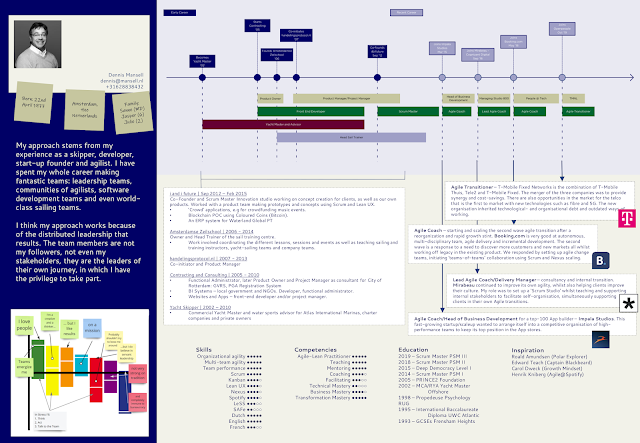
Dennis, in one page.

Image
I've made browsing my CV a bit less cumbersome:

Agile after Corona

Image
The Company to Consumer model under threat teambrunel.com Originally I became interested in agile software development when I started to discover a pattern between great teamwork in yacht racing and teams that produced software.  Some of the greatest software teams that I worked with were people working together on open source projects. Thousands of people worked together in self-organizing teams throughout their technology stack, much as if they had belonged to a single organization.  Could that model work in more organizations? There was an essential thing missing though - most of these teams were making things that were useful to themselves but not necessarily to a user who would be willing to pay.  Motivation was often very idealistic: working on free (as in liberty) software usually entailed working for free (as in beer).  Some projects became wildly successful, imagine a world without Linux , Wikipedia or Bitcoin .  But do you remember Joomla , M...

Why Scrum? Why Agile? Answering a Project Manager

Image
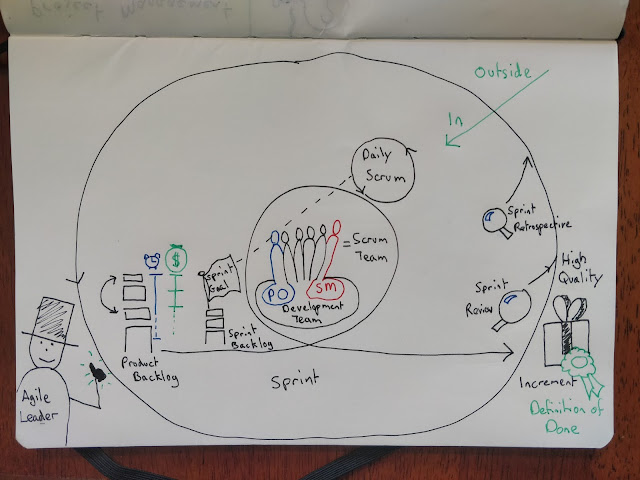
I'm a Project Manager, how will we organize projects with Scrum? Scrum has no Project Managers. Projects are generally only focussed on developing something, whereas Scrum Teams design, create and sustain something. Managers are generally responsible for something or some people, whereas Scrum Teams are self-organizing. In Scrum - as long as a product exists, it has a Product Backlog of everything that will be done to it. That includes, but is not limited to what can be termed 'projects', however it is ordered so that working on it, produces the maximum amount of value, first. In project management, value is assumed to be a function of the 'iron triangle' - this budget, spent in this time, with this scope of solutions will make the project done. Quality is a cost to these variables: running out of time or money whilst still making the same scope will lead to reducing the quality. This is working ‘inside out’ - from what we can make, towards value for customers. S...

Why Scrum? Why Agile? My Sailing Friends

Image
 After a day's sailing, we've dropped anchor, cleaned the boat and poured ourselves a drink. “So - what is it you do again?” “I’m a Scrum Master.  It’s like the Master of Sail on tall ships.” “What - like the second-in-command?” “No, I don’t have a position in the hierarchy.  I just make sure the boat and crew are fit for purpose and help the sailors and staff understand what is going on.” “Why would an organisation need that?” “Many organisations approach products as if it were an industrial process like transport.  They load the cargo containers as full as they can get - calling it ‘scope’, then they plan very exactly how to drive from A to B to predict the costs and how long it will take to deliver. “For my clients, their product doesn’t actually match this industrial process very well.  I get them to think of it as if they were explorers trying to reach some distant shore. “They should pack very light and get great at teamwork so that...

Why Scrum? Why Agile? CEO Elevator Pitch

Image
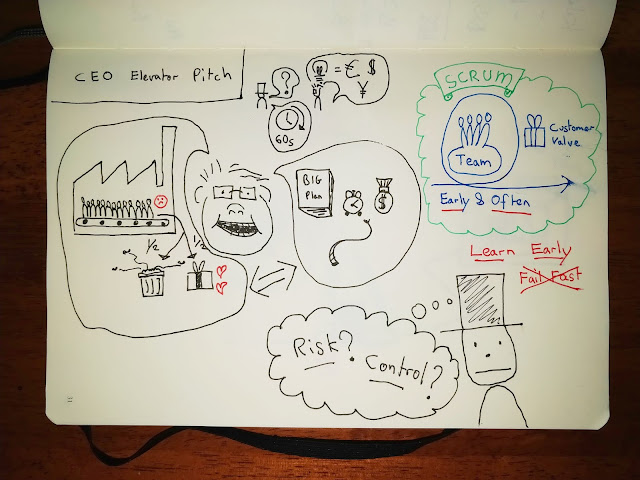
The second instalment of why Scrum, why Agile? What to say to a CEO... “What do you want?” “I have an idea that could be valuable to the company.” “You have 60 seconds” “We have a lot of people working on the product, but [enter employee survey here] shows that they are unhappy. They are also very clever, yet [some percentage of projects - usually ½ to ⅔] of our projects are failing - costing us a lot of money and frustration. Moreover [some big competitor] are moving faster than we are. Many of our people don't know who they create value for or why. “This is caused by our big plans and need to control the process. “We could take a small, self-organizing team, with all the necessary skills and permissions, and start releasing customer value early and often. It’s called Scrum - I’ve seen it work at a start-up but it also saved [some competitor] from going under.” “What’s in it for us? Sounds like we would lose control” “Scrum would at least show up ...

Why Scrum? Why Agile? The Cocktail Party Answer

Image
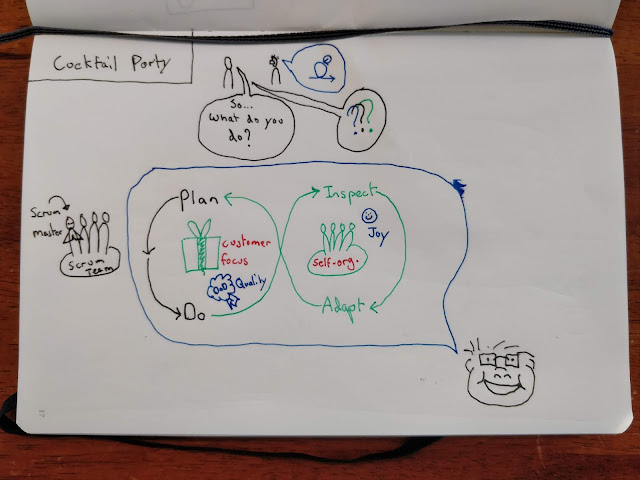
This series of blog posts is about giving answers to why Scrum and Agile exist. As a Scrum Master, I am regularly asked to quickly explain what I do, why the organisation needs me or what it gains from my presence. My answer is usually tailored to the person asking the question, here is an approach: Cocktail party answer: “So, what do you do?” “I’m a Scrum Master and an Agile Coach” “What’s that?” “It’s like a manager but with self-organising teams. The companies I work for are used to making big plans and then controlling all the steps of making a product. I help them to inspect and adapt their product and their organisation, continuously. It helps companies focus on their purpose and their customers, whilst their employees gain more enjoyment from delivering high-quality products.”

Scrum Studio - simple, end-to-end, adoptable

Image
I've written a blog post on our company blog about 'Scrum Studio' - a developing idea about how to re-think your teamwork to be simple,  end-to-end and with ways to adopt it.  In short: my take on the missing bits of Scrum.  A special shoutout to Gunther Verheyen and the rest of the Scrum Caretakers - as well as the fantastic members of Studio 800 and Team Oranje at Mirabeau . Click here for the blog post.

Johan Cruijff's Agile Mindset

I wrote a LinkedIn article after being inspired by Joost Icke's original piece . Johan Cruijff had some amusing sayings but also had a very deep understanding of team performance as a system.

From Workaholic to Value Ninja

Image
A not-so-recent post by user story god Mike Cohn drifted into my timeline today. I had just finished a user story mapping session at a client.  We ended our user story mapping session with three user stories as candidates for top-of-backlog that would clearly bring huge value to our client and a whole wall full of user stories that ranged from pretty cool to utterly pointless. In the evening I also received a bunch of time-sheets telling me how each team member had spent their hours. How are these two related? Being a workaholic Hi, I'm Dennis and I'm a recovering workaholic. I've had some pretty bad binges. I once worked so hard that I forgot when I had last eaten. My wife had to tell me that it had probably been more than 36 hours as I had left for the office the day before without breakfast and I hadn't left the office except for a quick cat-nap in between. I had a headache and was a bit dizzy but she had to point out to me that that proba...

How Agile Retrospectives Contribute For Team Learning

Image
Hello, I am privileged to be asked by Dennis Mansell to write a guest post about this fascinating and important topic: Agile Retrospective . Agile retrospective plays an important role in team building and should be performed at the end of every sprint. The process helps the team identify what worked and what didn’t so that they can make improvements in the next Sprint. For teams’ new to the process, they can do these easy exercises to help facilitate their meetings. The Sailboat Retrospective In this exercise, the facilitator draws a sailboat in the middle of a whiteboard or large poster paper. To represent the team. Team members then write on post it notes what they felt was an anchor (something that held them back) and what was the wind (parts of the project that worked and moved them forward). After place the anchors and wind on the board by the sailboat, the team discusses their findings. The Starfish Retrospective The facilitator draws a starfish shape to div...